
Marketing vs. Reality
In the course of working in flooring sales, I’ve earned a bit of a reputation as “that guy” when reps come to visit – the one who listens to all the great things about a new product, then says, “so.” It’s no fault of the rep. I am a self-proclaimed geek when it comes to carpet and flooring. They’re on a call with their marketing department, who tells them they’ve come up with a fantastic new product and hands them all the bells and whistles on why it’s better than anything else out there. But when it all boils down, it’s usually the same product as their last one, just with a different bevel, a different thickness, or a different yarn twist.
Some products really have shaken up the industry – Waterproof Polymer Core or Wood Polymer Core (WPC) vinyl plank, Stone Polymer Core or Stone Polymer Composite (SPC) vinyl plank, solution-dyed yarns – but most everything else is copy and paste with a different color. It’s the marketing behind them that gets retailers and customers into trouble.
“Waterproof Laminate”
Back when laminate (PERGO) first came to the U.S., in 1994, it was an innovative product nobody had seen before. No one really knew what it could do, what its limitations were, or what the best application for it was. The first generation of laminate floors were glued together, creating a floating, solid unit floor. When locking mechanisms came along, the floors moved mostly like a solid unit, but once locked in (and with the lack of expansion spacing) they behaved differently, and they weren’t as impervious to water as that first generation. When water got between the edges, the core would swell, the planks would come apart, and the floor looked terrible.
One manufacturer at Surfaces, the largest flooring show, built a display one year with laminate sitting under a waterfall, claiming their laminate held up to water better than the rest. The display turned a lot of heads – the planks looked great after sitting underwater all day. Years later, I found out they replaced the display planks every single day, because they still swelled. Great marketing, poor reality.
I could go on about “waterproof floors” – in fact, I wrote a whole article about how they’re only warranted “waterproof” from the top down: mark4floors.com/articles/waterproof-flooring.
“It Can Go Over Anything”
When CoreTec first came out, I was fairly new to sales but had a few years of inspection experience behind me. What caught my attention on the displays was this picture:
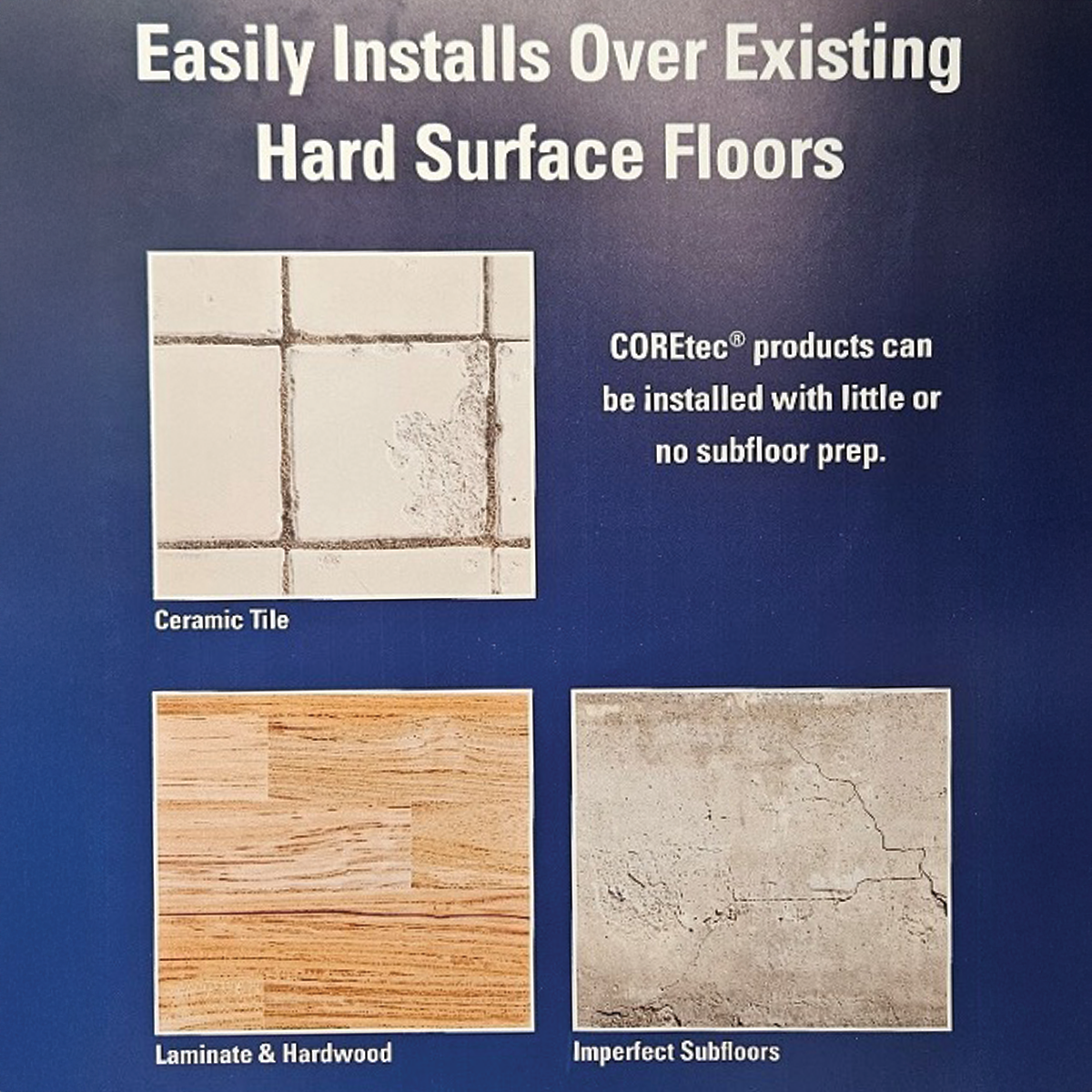
Looks great, doesn’t it? It can go over laminate?! With little to No floor prep needed on your tile floor or subfloor?! I even remember briefly they said it could be installed over carpet. Now let’s read the installation instructions:
“All subfloors must be clean, flat, dry, and structurally sound. The correct preparation of the subfloor is a major part of a successful installation. Subfloor must be flat: 3/16" in 10’ or 1/8" in 6’.
Flooring can be installed over most existing hard-surface floor coverings, provided that the existing floor surface is fully adhered, clean, flat, dry, structurally sound, and free of deflection.
This product can be installed over existing ceramic/porcelain tile products with up to a 1/4 inch wide grout joint. If the grout joint width exceeds 1/4 inch, a cementitious patching compound should be used to fill the joint smooth with the tile surface.”
A laminate floor isn’t “fully adhered.” Imperfect subfloors are fine, as long as they’re flat. And I still haven’t met an installer who followed the tile installation directions and didn’t end up back on that job years later because the tile pattern was telegraphing through (that was on the first generation, anyway). Again, the marketing looks great, but the realities of the product fall short. I even asked a rep, while looking straight at the display, “Really, no prep on the tile?” He seemed thrilled to say “Yes!” I gave him a “we’ll see” look.
“You Can Use Bleach on Your Carpet!”
One of the best inventions to come out of carpet in years is solution-dyed yarn. It had been used commercially for a long time, but it was too costly for residential use until recently. Mohawk’s SmartStrand (Triexta) yarn isn’t fully solution-dyed, but the makeup of the fiber chemistry makes it very hard to stain or discolor. When it first launched, some advertising claimed you could use bleach to clean it. No manufacturer approves bleach for cleaning any carpet, but the marketing stuck. Some of my fellow salespeople still work that line into their pitch. Other major manufacturers now use solution-dyed yarns too, with similar advertising to match. I’ve had customers come in with real problems because they used the wrong cleaner on their carpet. The advertising is out there, but it’s always best to follow the manufacturer’s instructions, not their marketing.
Marketing is great. It sells products and helps manufacturers differentiate what they offer. What it doesn’t do is give you realistic expectations for the product. A good salesperson cuts through the marketing to tell you what “latest and greatest” actually means for you as a customer. There’s nothing wrong with being “that guy.” That’s the person who doesn’t want to be sold a product, that’s the person who wants to understand it.